Friday, June 19, 2020

What is a Transistor ?

The transistor is a semiconductor device which transfers a weak signal from low resistance circuit to high resistance circuit. The words trans mean transfer property and istor mean resistance property offered to the junctions. In other words, it is a switching device which regulates and amplify the electrical signal likes voltage or current.


Why Do We Need Transistors?

Suppose that you have a FM receiver which grabs the signal you want. The received signal will obviously be weak due to the disturbances it would face during its journey. Now if this signal is read as it is, you cannot get a fair output. Hence we need to amplify the signal. Amplification means increasing the signal strength.
This is just an instance. Amplification is needed wherever the signal strength has to be increased. This is done by a transistor. A transistor also acts as a switch to choose between available options. It also regulates the incoming current and voltage of the signals.

Constructional Details of a Transistor

The Transistor is a three terminal solid state device which is formed by connecting two diodes back to back. Hence it has got two PN junctions. Three terminals are drawn out of the three semiconductor materials present in it. This type of connection offers two types of transistors. They are PNP and NPN which means an N-type material between two Ptypes and the other is a P-type material between two N-types respectively.
The construction of transistors is as shown in the following figure which explains the idea discussed above.
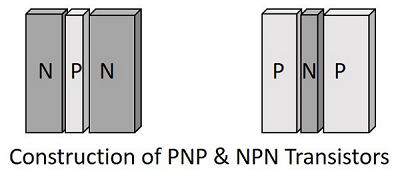
Construction of Transistor
The three terminals drawn from the transistor indicate Emitter, Base and Collector terminals. They have their functionality as discussed below.

Emitter

  • The left hand side of the above shown structure can be understood as Emitter.
  • This has a moderate size and is heavily doped as its main function is to supply a number of majority carriers, i.e. either electrons or holes.
  • As this emits electrons, it is called as an Emitter.
  • This is simply indicated with the letter E.

Base

  • The middle material in the above figure is the Base.
  • This is thin and lightly doped.
  • Its main function is to pass the majority carriers from the emitter to the collector.
  • This is indicated by the letter B.

Collector

  • The right side material in the above figure can be understood as a Collector.
  • Its name implies its function of collecting the carriers.
  • This is a bit larger in size than emitter and base. It is moderately doped.
  • This is indicated by the letter C.

The symbols of PNP and NPN transistors are as shown below.
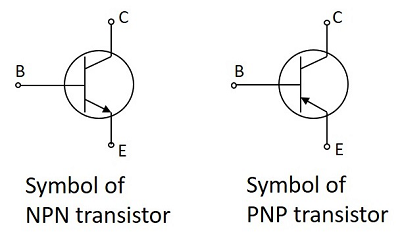
Symbols of Transistors

Advantages

There are many advantages of a transistor such as −
  • High voltage gain.
  • Lower supply voltage is sufficient.
  • Most suitable for low power applications.
  • Smaller and lighter in weight.
  • Mechanically stronger than vacuum tubes.
  • No external heating required like vacuum tubes.
  • Very suitable to integrate with resistors and diodes to produce ICs.

What is a Capacitor And Uses? Tech Talk #2


What is a Capacitor


  • A two terminal electronic component which stores energy in form of charge.
  • capacitance is a measure of a capacitor ability to store charge.
  • A large capacitance means that more charge can be stored.
  • Capacitance is measured in Farads(F) but prefixes like µF and pF for smaller values Conductor that can hold charge.
  • For our propose two conductors one with charge + Q and one with charge Q.
  • We “charge” a capacitor by connecting it to a battery
  • when we disconnect the battery charge remain on the conductor
  • if we connect conductor charge will then flow from one to another

   Why Are Capacitors Useful ?

  • capacitor can provide uniform electric field we use them to accelerate or deflect charged Bheem etc.
  • we can store charge for later use we can charge many capacitors and then discharge them at one time to produce very large currents for short time.
  • capacitor important in AC circuit 

Formula

  •   We Find that voltage is directly proportional to charge

  • Q=Charge
  • C=Capactance
  • V=Voltage
  • Capactance=Q=CV

Type of Capacitor

Paper Capacitor

Mica Capacitor

Ceramic Capacitor

Electrolytic Capacitor

Variable Capacitor

Variable Capacitor


Practical Use

  • Used for making timer circuits, when used with  resistance.
  • Used in clipper, clamper circuit.
  • Used for providing instantaneous large power as in flashlight of cameras.
  • Used in DC filter circuits. 
  • Used in Ac circuit also


    Thursday, June 18, 2020

    What is Arduino ?


    What is Arduino?

    Arduino is an open-source electronics platform based on easy-to-use hardware and software. Arduino boards are able to read inputs - light on a sensor, a finger on a button, or a Twitter message - and turn it into an output - activating a motor, turning on an LED, publishing something online. You can tell your board what to do by sending a set of instructions to the microcontroller on the board. To do so you use the Arduino programming language (based on Wiring), and the Arduino Software (IDE), based on Processing.


    Over the years Arduino has been the brain of thousands of projects, from everyday objects to complex scientific instruments. A worldwide community of makers - students, hobbyists, artists, programmers, and professionals - has gathered around this open-source platform, their contributions have added up to an incredible amount of accessible knowledge that can be of great help to novices and experts alike.

    Arduino was born at the Ivrea Interaction Design Institute as an easy tool for fast prototyping, aimed at students without a background in electronics and programming. As soon as it reached a wider community, the Arduino board started changing to adapt to new needs and challenges, differentiating its offer from simple 8-bit boards to products for IoT applications, wearable, 3D printing, and embedded environments. All Arduino boards are completely open-source, empowering users to build them independently and eventually adapt them to their particular needs. The software, too, is open-source, and it is growing through the contributions of users worldwide.

    Why Arduino?

    Thanks to its simple and accessible user experience, Arduino has been used in thousands of different projects and applications. The Arduino software is easy-to-use for beginners, yet flexible enough for advanced users. It runs on Mac, Windows, and Linux. Teachers and students use it to build low cost scientific instruments, to prove chemistry and physics principles, or to get started with programming and robotics. Designers and architects build interactive prototypes, musicians and artists use it for installations and to experiment with new musical instruments. Makers, of course, use it to build many of the projects exhibited at the Maker Faire, for example. Arduino is a key tool to learn new things. Anyone - children, hobbyists, artists, programmers - can start tinkering just following the step by step instructions of a kit, or sharing ideas online with other members of the Arduino community.

    There are many other microcontrollers and microcontroller platforms available for physical computing. Parallax Basic Stamp, Netmedia's BX-24, Phidgets, MIT's Handyboard, and many others offer similar functionality. All of these tools take the messy details of microcontroller programming and wrap it up in an easy-to-use package. Arduino also simplifies the process of working with microcontrollers, but it offers some advantage for teachers, students, and interested amateurs over other systems:

    • Inexpensive - Arduino boards are relatively inexpensive compared to other microcontroller platforms. The least expensive version of the Arduino module can be assembled by hand, and even the pre-assembled Arduino modules cost less than $50
    • Cross-platform - The Arduino Software (IDE) runs on Windows, Macintosh OSX, and Linux operating systems. Most microcontroller systems are limited to Windows.
    • Simple, clear programming environment - The Arduino Software (IDE) is easy-to-use for beginners, yet flexible enough for advanced users to take advantage of as well. For teachers, it's conveniently based on the Processing programming environment, so students learning to program in that environment will be familiar with how the Arduino IDE works.
    • Open source and extensible software - The Arduino software is published as open source tools, available for extension by experienced programmers. The language can be expanded through C++ libraries, and people wanting to understand the technical details can make the leap from Arduino to the AVR C programming language on which it's based. Similarly, you can add AVR-C code directly into your Arduino programs if you want to.
    • Open source and extensible hardware - The plans of the Arduino boards are published under a Creative Commons license, so experienced circuit designers can make their own version of the module, extending it and improving it. Even relatively inexperienced users can build the breadboard version of the module in order to understand how it works and save money.
                                  
              Download the Arduino IDE
    ARDUINO 1.8.13
    The open-source Arduino Software (IDE) makes it easy to write code and upload it to the board. It runs on Windows, Mac OS X, and Linux. The environment is written in Java and based on Processing and other open-source software.
    This software can be used with any Arduino board.
    .       
          Downlode link- Windows app Requires Win 8.1 or 10 


             Installation Video-  https://youtu.be/SLWwW172lgw


    WHAT IS A RESISTOR? Tech Talk #1

    WHAT IS A RESISTOR?

    Resistor is a passive two-terminal element to resist electric current in electric circuits

    The resistor is a passive electrical component to create resistance in the flow of electric current. In almost all electrical networks and electronic circuits they can be found. The resistance is measured in ohms. An ohm is the resistance that occurs when a current of one ampere passes through a resistor with a one volt drop across its terminals. The current is proportional to the voltage across the terminal ends. This ratio is  represented by Ohm’s law:

    formula with ohm's law: R=V/I

    Resistors are used for many purposes. A few examples include delimit electric current, voltage division, heat generation, matching and loading circuits, control gain, and fix time constants. They are commercially available with resistance values over a range of more than nine orders of magnitude. They can be used to as electric brakes to dissipate kinetic energy from trains, or be smaller than a square millimeter for electronics.

    Video link-https://youtu.be/PUUP6XoxlHQ


    How to build 12V Battery Charger with Charging Protection?

    Auto Cut Off 12V Battery Charger with Charging Protection and Full Charge Indicator

     
    Components Required;-
    • TRANSFORMER 12V-0-12V/3A 
    • DIODE FR306/1N5408 -4
    • CAPACITOR 3300UF/25V-1
    •  ICLM317-1 
    • 10K POTENTIO METER-2
    • 220OHM RESISTOR-1/4W-1
    • 12VDC RELAY-1
    •  RED AND BLUE 3MM LED-2
    • 1K RESISTANCE-1
    •  HEAT SINK -1
    • SINGLE STRANDED WIRE
    CONNECTION DIAGRAM- https://drive.google.com/file/d/1v1YeB-du0x2fxhUWOytmcIh70tvN70MK/view


    FOR THE WHOLE PROCEDURE OPEN THE BELOW LINK-TECH PRO

    Featured Post

    What is a Transistor ? The transistor is a semiconductor device which transfers a weak signal from low resistance circuit to high re...

    Popular Posts