
What is a Transistor ?
The transistor is a semiconductor device which
transfers a weak signal from low resistance circuit to high resistance circuit.
The words trans mean transfer property and istor mean resistance
property offered to the junctions. In other words, it is a switching
device which regulates and amplify the electrical signal likes voltage or
current.


Why Do We Need Transistors?
Suppose that you have a FM receiver which grabs the signal you want. The received signal will obviously be weak due to the disturbances it would face during its journey. Now if this signal is read as it is, you cannot get a fair output. Hence we need to amplify the signal. Amplification means increasing the signal strength.
This is just an instance. Amplification is needed wherever the signal strength has to be increased. This is done by a transistor. A transistor also acts as a switch to choose between available options. It also regulates the incoming current and voltage of the signals.
Constructional Details of a Transistor
The Transistor is a three terminal solid state device which is formed by connecting two diodes back to back. Hence it has got two PN junctions. Three terminals are drawn out of the three semiconductor materials present in it. This type of connection offers two types of transistors. They are PNP and NPN which means an N-type material between two Ptypes and the other is a P-type material between two N-types respectively.
The construction of transistors is as shown in the following figure which explains the idea discussed above.
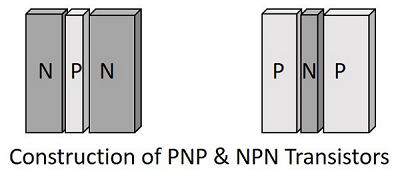
The three terminals drawn from the transistor indicate Emitter, Base and Collector terminals. They have their functionality as discussed below.
Emitter
- The left hand side of the above shown structure can be understood as Emitter.
- This has a moderate size and is heavily doped as its main function is to supply a number of majority carriers, i.e. either electrons or holes.
- As this emits electrons, it is called as an Emitter.
- This is simply indicated with the letter E.
Base
- The middle material in the above figure is the Base.
- This is thin and lightly doped.
- Its main function is to pass the majority carriers from the emitter to the collector.
- This is indicated by the letter B.
Collector
- The right side material in the above figure can be understood as a Collector.
- Its name implies its function of collecting the carriers.
- This is a bit larger in size than emitter and base. It is moderately doped.
- This is indicated by the letter C.
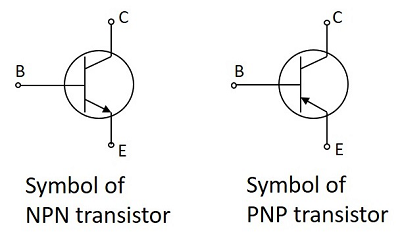
The symbols of PNP and NPN transistors are as shown below.
Advantages
There are many advantages of a transistor such as −
- High voltage gain.
- Lower supply voltage is sufficient.
- Most suitable for low power applications.
- Smaller and lighter in weight.
- Mechanically stronger than vacuum tubes.
- No external heating required like vacuum tubes.
- Very suitable to integrate with resistors and diodes to produce ICs.
Video link - https://youtu.be/K0iOIcni6Oc


No comments:
Post a Comment